Boat pre-departure checklist UK:
before you leave the marina
Before casting off, review the weather and tides, check your route and alternatives, prepare the boat, and brief the crew. Use the checklist below as a starting point, then add the checks required by your own vessel and equipment.
A familiar berth can make a departure feel routine. A repeatable check gives you time to notice a fault while you still have options. Tick a box only after checking; an unchecked item needs a decision, not a hurried assumption.
Your quick pre-departure checklist
These ticks are temporary and are not saved. Print this page or use your own boat-specific record.
If an essential check fails, resolve it, change the plan or stay alongside.
Printing includes the explanatory guide. Your browser can also save it as a PDF.
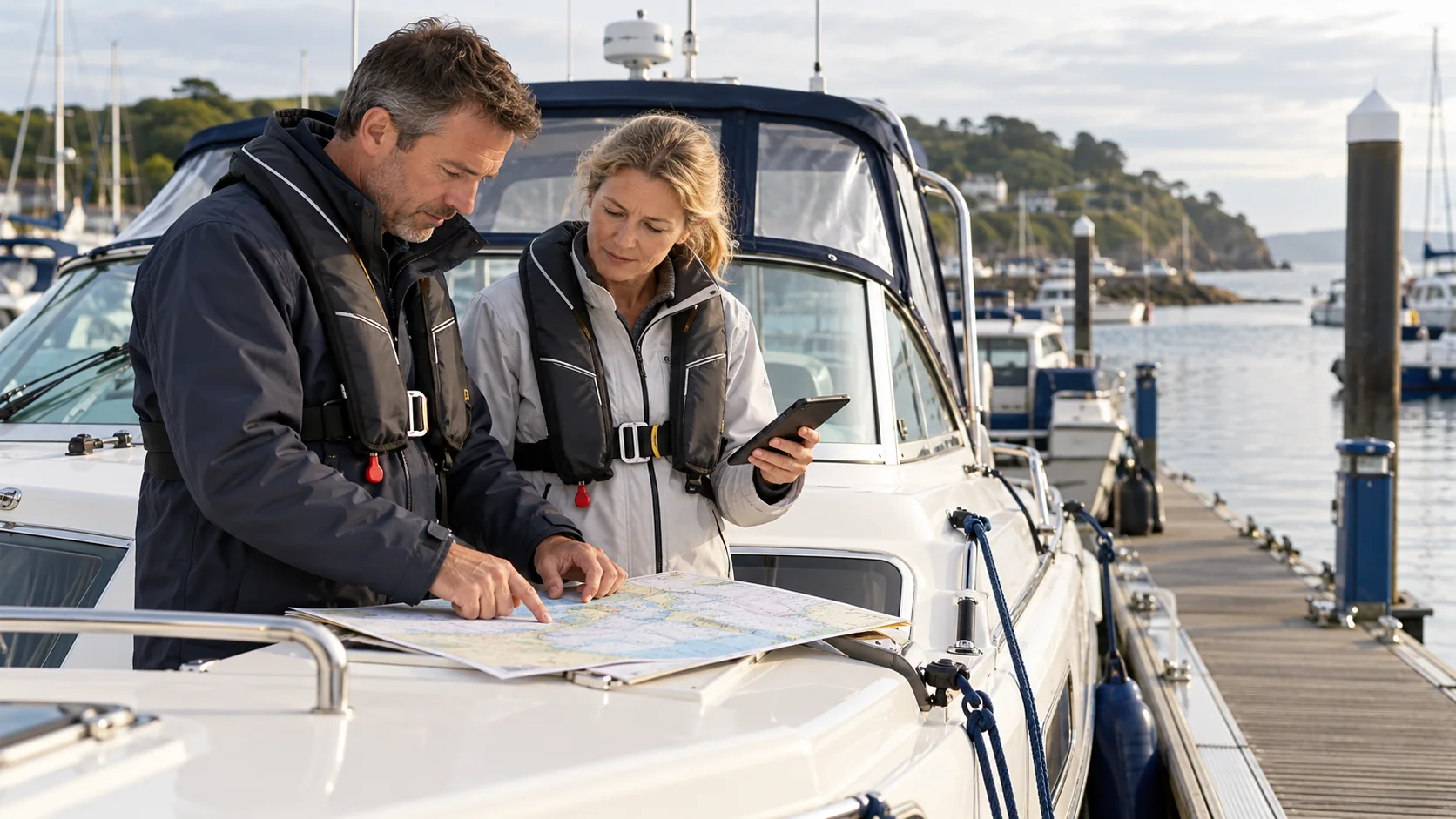
1. Check the conditions for departure and return
Read an appropriate marine forecast for your area, including wind, visibility and sea state. Look at how conditions may change before you get home, rather than relying on the view from a sheltered berth.
Use current tidal predictions and local harbour information. Check the time basis, entrance restrictions and any depth or stream constraints. Decide what would make you delay or turn back before the trip becomes a commitment. RYA passage-planning guidance provides further context.
2. Plan the whole passage, with an alternative
Use our coastal passage-planning guide and printable template to organise the route, timings and decision points.
Include leaving the berth, the harbour exit, the open-water legs and arrival. Identify hazards and a usable alternative if the intended destination becomes unsuitable. Match the journey to the boat, available daylight and crew capability.
Tell a reliable contact ashore where you intend to go and when you expect to return. Agree what they should do if you are overdue, and remember to close the loop when safely back. A plan is useful only if someone can act on it.
3. Check the boat using its own procedures
Our marine diesel daily-checks guide and printable checklist explains the engine checks before starting and after start-up.
Follow your vessel and engine manuals. Inspect for leaks or changes, check the bilge and verify fuel, fluid levels, steering and essential electrical supplies. Check relevant cooling-water intakes and their required valve positions before starting. Never assume every seacock should be open or closed.
After starting, follow the engine’s checks for cooling-water discharge where applicable, instruments and alarms. Keep clear of moving and hot parts. Check gear operation only where it can be done safely, with the boat controlled and the propeller area clear. Use and test the kill cord where fitted, following the manufacturer’s procedure.
Real-world pitfall: an engine starting successfully does not prove that it has cooling water or enough usable fuel for the passage. Investigate an abnormal indication before departure.
4. Make safety equipment accessible
Wear an appropriate, correctly fitted lifejacket or buoyancy aid for the activity. Check it using the manufacturer’s instructions. Confirm that emergency equipment is suitable, maintained and accessible, rather than buried beneath bags.
Have a working means of calling for help, know your position and ensure the crew can use the equipment. Do not rely on mobile-phone coverage offshore. Prepare an appropriate anchor and rode for the boat and area. The RNLI’s equipment guidance explains these essentials.
5. Give a short, practical crew briefing
Explain the destination, expected conditions and each person’s job. Demonstrate safe movement, lifejacket use and where emergency equipment is kept. Discuss man-overboard actions and how to raise the alarm.
Identify someone who can take over basic control and call for help if the skipper cannot. Invite questions about confidence, mobility, seasickness or other needs that could affect the trip. A briefing works when the crew understand it, not when the skipper has finished speaking.
6. Pause before casting off
Explain the departure manoeuvre: which line comes off when, who handles it, and what happens if you need to stop. Prepare fenders and lines, check shore connections and secure loose equipment.
Look around once more. Check people, nearby craft and the intended escape route. If something no longer fits the plan, pause. There is no benefit in completing a checklist quickly if a new problem has appeared.
Keep checking after you leave
Departure is the start of monitoring, not the end. Maintain a lookout, review the conditions and watch relevant instruments. Record useful observations and reassess the plan when the situation changes.
Turn the checks into useful boat records
The Helmlore Skipper’s Handbook & Boat Owner’s Workbook brings together eight coastal modules, practice questions with answers and explanations, and printable companions for preparation and record keeping.
Your £19.95 digital bundle includes a 262-page handbook, skipper’s logbook, onboard emergency cards, grab-bag checklist and eleven reusable worksheets.
See the handbook and actual page previews →
Independent recreational learning. No official qualification is awarded.
Build the knowledge behind your checklist
- Safety Awareness at Sea — preparation, hazards and crew awareness.
- Boat Systems & Stability — understand the equipment you are checking.
- Passage Planning & Logbook — connect preparation with the whole journey.
- Try the free buoyage lesson — no account needed.
Keep building your passage knowledge
Revisit tidal heights and streams before working out an arrival window, and bridge watchkeeping before taking a watch. If you are choosing a vessel, use the UK first-boat buying guide before committing to a purchase.
Sources and further reading
This is Helmlore’s own practical guide, informed by the guidance below. The organisations linked have not endorsed this article or the handbook.
- RNLI: preparation and crew-briefing checklists
- RNLI: equipment for going afloat
- RYA: passage planning
- HM Coastguard: recreational boating safety
Updated 22 October 2026. Adapt this guide to your vessel, area and crew. Use current operational information, equipment instructions and practical training.