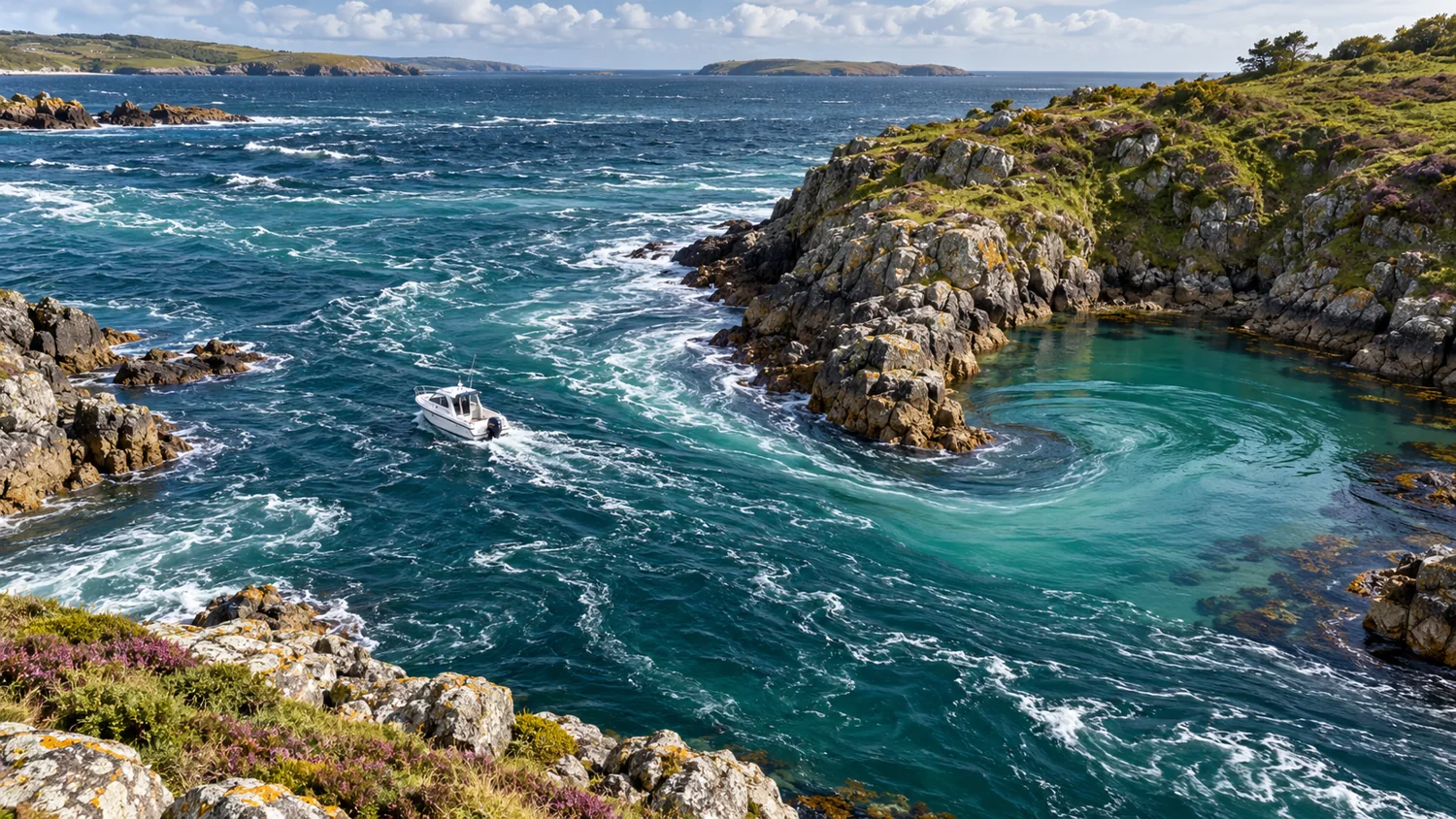
What you’ll explore
Tides affect both the water available beneath your boat and the movement of water along your passage. This pathway connects tidal heights with tidal streams so you can practise thinking about depth, timing, set and drift together.
- Tide cycle
- Chart datum
- Tide tables
- Tidal heights
- Tidal streams
- Set and drift
- Stream atlas
- Passage windows
Put the learning into practice
Practise interpreting tide information and connecting stream direction and strength with passage timing.
Work at your own pace and revisit the subjects you want to practise. Your free Helmlore account keeps your learning progress together.
Tidal height and tidal stream answer different questions
Tidal height helps you estimate the water depth at a place and time. Tidal stream describes the movement of that water, affecting your course and progress over the ground. High water does not necessarily coincide with slack water: consult the local tidal information rather than assuming the two occur together.
Worked example: how much water is beneath the keel?
Fictional learning example: a chart shows a submerged depth of 1.2 m below chart datum. The predicted height of tide at the relevant place and time is 2.4 m above the same datum. The boat’s loaded draught is 1.6 m.
- Estimated water depth: 1.2 + 2.4 = 3.6 m.
- Estimated static under-keel clearance: 3.6 − 1.6 = 2.0 m.
- Compare that result with an appropriate planned clearance and allowances for the boat, location and conditions.
This simplified arithmetic does not establish that a passage is safe. Waves, heel, squat, weather-related water-level changes, chart accuracy and changing seabed conditions can reduce the clearance available. Check the depth-sounder offset too: a reading may be referenced to the transducer, waterline or keel.
Try an explained tide question
Question: In the same fictional example, the predicted height of tide falls to 1.4 m. What is the estimated static under-keel clearance?
Answer: 1.2 + 1.4 − 1.6 = 1.0 m. One metre less tide means one metre less static clearance. This is a calculation result, not a recommended minimum clearance.
Connect the calculation to your passage
Check the tide-table date, location, time zone and datum; use the appropriate local predictions and corrections. Consider the depth throughout your arrival window and return, not just at departure. Read our coastal passage-planning guide and pre-departure checklist to connect tide calculations with practical preparation.
Further reading: The Nautical Institute: under-keel clearance. Learning example reviewed 22 October 2026.